
There seems to be a universal directive from senior management being given to every customer service team right now. “We need to be doing more with AI.”
So what does that actually mean for your organisation, right now? How are you enabling AI use in your team of customer service agents and in your contact center systems?
The pressure to act on AI and customer service is real. There is no shortage of AI tools for customer support, the options are endless. The biggest question for Managers is “what is the best way forward to introduce AI into your customer support channels?
It comes down to where your organisation is on the AI maturity curve.
So where are you on the AI maturity curve? Read on to find out.
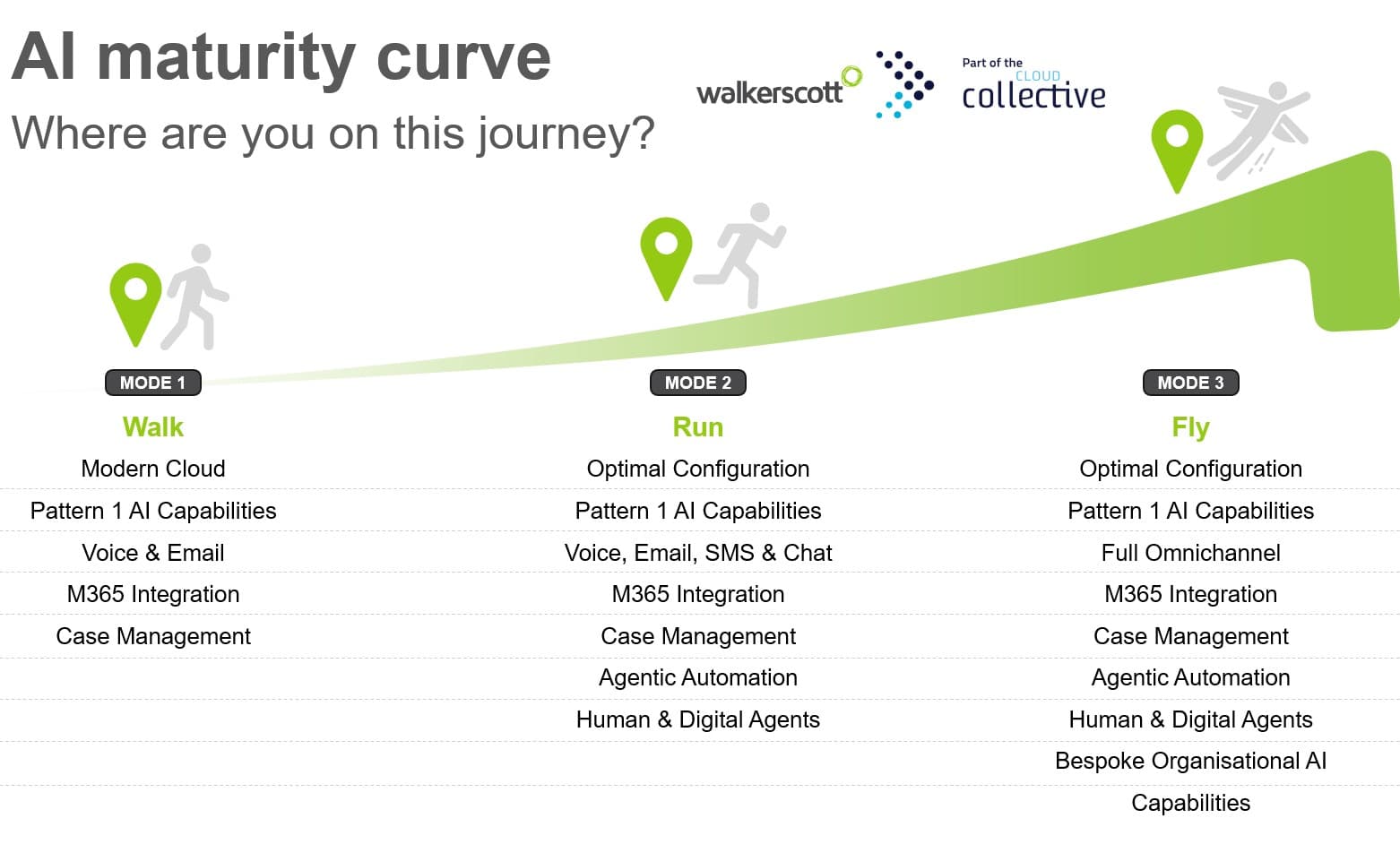
There are 3 operating modes in deploying artificial intelligence into your customer care.
A useful way to think about AI maturity in customer service is not as a technology checklist, but as a set of operating modes, each representing a different relationship between your human agents and the customer service AI working alongside them.
Mode 1: Human with customer service AI assistant
This is where most contact centres start, and it’s further along than many teams realise. An agent handles every interaction, but AI tools for customer support are working in the background, helping surface relevant information, suggesting knowledge articles, summarising the case so far, and flagging customer sentiment in real time. The human is always in control. The AI reduces effort and improves consistency.
If your agents are currently spending time on after-call notes, searching across multiple systems for customer history, or manually reviewing calls for quality assurance, this is the mode that addresses it. The wins here are real, measurable, and typically visible within weeks of going live.
Watch a demonstration of embedded AI in Dynamics 365 Contact Center
Mode 2: Human-led, customer service AI agents executing tasks
At this level, AI customer support starts to handle discrete parts of the service process rather than just assisting with them. An AI IVR – rather than a traditional “press 1 for Sales” menu – handles the opening conversation generatively, understanding customer intent in natural language before routing to the right place. An AI customer service agent automatically creates and categorises the case after a chat interaction ends. Quality evaluation of calls happens automatically, with a scored summary waiting for the team leader rather than a manual review queue.
Your human agents are still at the centre of complex customer interactions and anything requiring judgement or empathy. But the volume of repetitive digital labour, such as the tasks that don’t require a human but currently consume one anyway, starts to shift. This is where AI for customer care moves from a productivity tool to a genuine operating model change.
This is also where good AI governance becomes important. You need to be confident in what the AI is doing, why it’s doing it, and where the guardrails are.
Mode 3: Human-led, AI customer service agent operated end-to-end
At this level, artificial intelligence and customer service operate as a genuinely integrated workforce. AI can run part of or all of a support workflow end-to-end. A customer’s query is handled from first contact through to resolution without a human agent involved at any point, unless the AI recognises that human judgement, empathy, or escalation is needed, at which point it hands over with full context intact to a human agent.
Humans in this model play an elevated role, not a reduced one. They’re setting direction, handling the interactions that genuinely require a person, and overseeing an AI-powered customer service operation that manages the predictable, repeatable volume. This is what artificial intelligence customer service looks like when the platform and the operating model have caught up with each other.
Most organisations are not at mode 3 yet, and don’t need to be. But understanding what it looks like matters, because it changes how you make technology decisions today.
Find out where you are on the AI maturity curve, take the quiz.
Before deciding where to go next, it’s worth being clear about where you actually are. These questions are a starting point.
Are you using AI anywhere in your contact centre today?
If yes, is it delivering consistent value, or is it a pilot that never quite scaled?
Are your agents spending time on tasks the system should be handling or is the platform doing that work for them?
Tasks like after-call notes, manual case creation, looking up knowledge articles.
How many interactions does your QA process actually review?
If the answer is a small fraction, you’re making coaching decisions with limited visibility.
If several of these questions surface gaps, you’re likely in Mode 1 territory, or earlier. That’s not a problem, it’s a starting point.
The most common mistake we see in organisations deploying AI in their customer support operations.
The most expensive mistake organisations make with AI customer care isn’t moving too slowly. It’s adding customer care AI tools to a fragmented technology ecosystem and expecting them to perform as though every system was connected.
Artificial intelligence customer care doesn’t fix fragmentation, it inherits it.
This is what is looks like:
- An IVR AI that can’t see the customer’s case history.
- Sentiment analysis limited to one channel.
- Copilot working with incomplete data because the CRM and telephony system don’t share a common layer.
This is why your contact center platform matters. Organisations that progress through these maturity levels most effectively build on a connected foundation from the start – one where telephony, CRM, case management, and AI share data by default, not by integration effort. AI-powered customer service only delivers its full value when the data layer underneath it is unified.
You don’t need to go from walk to fly overnight.
The maturity model is not a race. A healthcare organisation with strict data governance requirements will take a different path to a retail business with high chat volume and straightforward query types. Both can progress. Neither should be pressured to skip a stage they’re not operationally ready for.
What matters is having a clear picture of where you are, a realistic view of where you want to be, and an implementation approach that gets you moving without committing to a multi-year transformation before you’ve seen what the system can actually do.
In our experience, the 80/20 rule applies consistently: the standard platform delivers around 80% of the value straight out of the box (Dynamics 365 Contact Center) whether that’s AI customer support tools, an AI IVR, agent assist, or automated case management. That value can be realised quickly, without months of heavy discovery. The remaining 20% – the configuration specific to your workflows, your team structure, your customer base – is almost always better done once the system is live and being used, not designed upfront based on assumptions.
What is the next step for you?
Book a path to Ascent workshop
Walkerscott’s path to Ascent workshop is a half day session designed to give contact centre leaders a clear picture of where they are on the maturity curve, which channels and artificial intelligence call centre capabilities will deliver the quickest return, and what a phased roadmap to a modern, connected contact centre looks like for their organisation specifically.
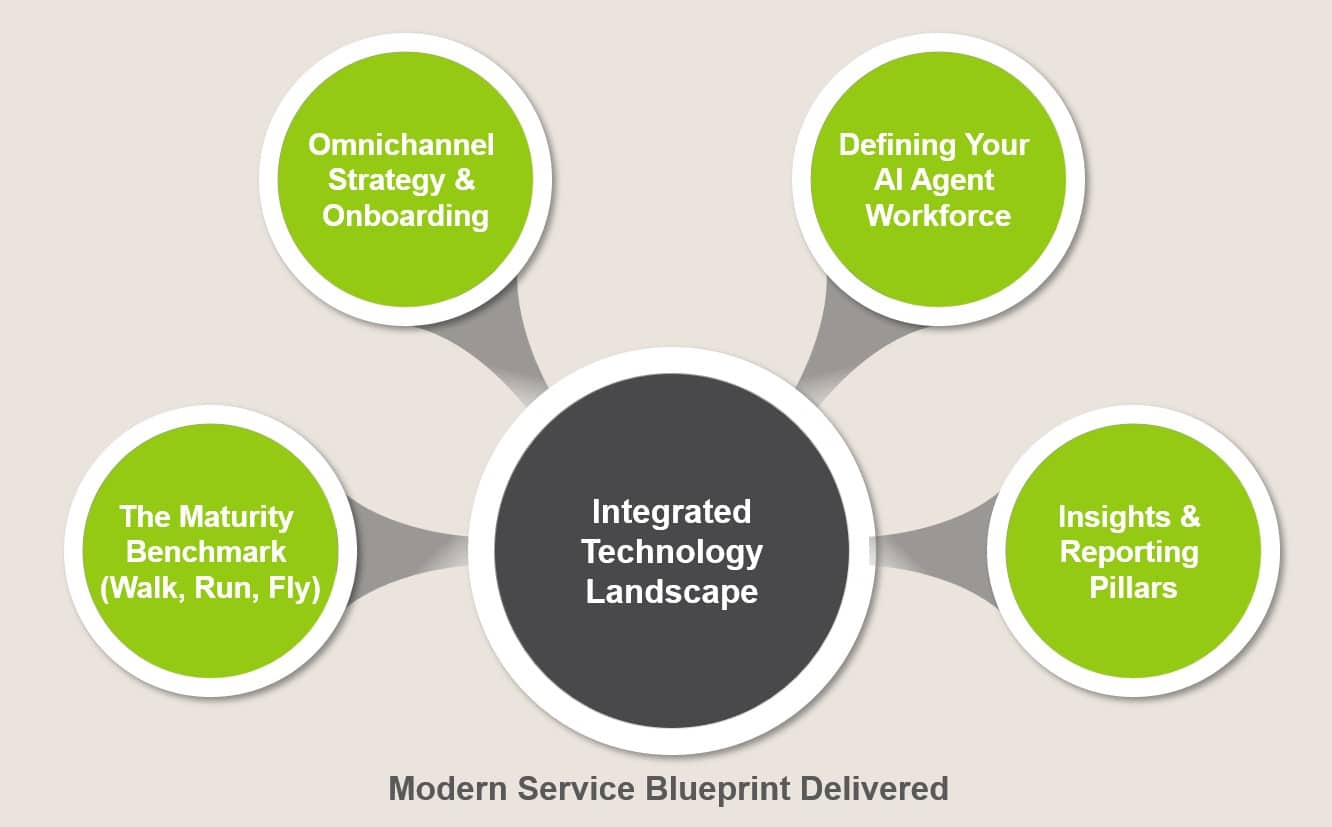
It’s practical, not theoretical. And it gives you something useful whether you’re ready to move immediately or still building the internal business case.