Under New Zealand Government Procurement Rule 44, e‑Invoicing Capability becomes mandatory for government agencies in 2026 and for large suppliers from 1 January 2027.
This article explains which organisations are affected, what Rule 44 requires, and how Dynamics 365 Business Central, supported by Continia, enables full e‑Invoicing Capability.
What organisations in New Zealand must comply with Rule 44 e-Invoicing, and when?
By 1 January 2026
All New Zealand Government agencies that receive more than 2,000 domestic trade invoices annually must be capable of receiving Peppol e‑invoices through their primary accounts payable system(s).
By 1 January 2027
Government Agencies must require large suppliers to submit Peppol e‑invoices.
A large supplier is defined by section 45(b) of the Financial Reporting Act 2013, meaning organisations with more than NZD 33 million in revenue across the entity and subsidiaries for each of the two preceding accounting periods.
Rule 44 also clarifies:
- The requirement applies only to domestic trade credit invoices
- Certain payment types (e.g., rents, leases, credit card statements, insurance premiums) are out of scope
- Agencies must ensure their systems and processes are ready to support Peppol e‑invoicing
What e‑Invoicing Capability means under Rule 44?
Rule 44 defines e‑invoicing as the direct exchange of structured invoice data between systems using the secure Peppol network. E-Invoicing capability under Rule 44 means:
- Peppol based structured data, not emailed documents
- System‑to‑system exchange, not manual entry or scanning
- Verified business identifiers, not email addresses
- A secure, standardised network, not ad‑hoc formats
This structured approach reduces manual processing, strengthens protection against payment‑redirection fraud, and supports faster payment cycles, including the five day payment commitment for Peppol invoices submitted to New Zealand Government agencies.
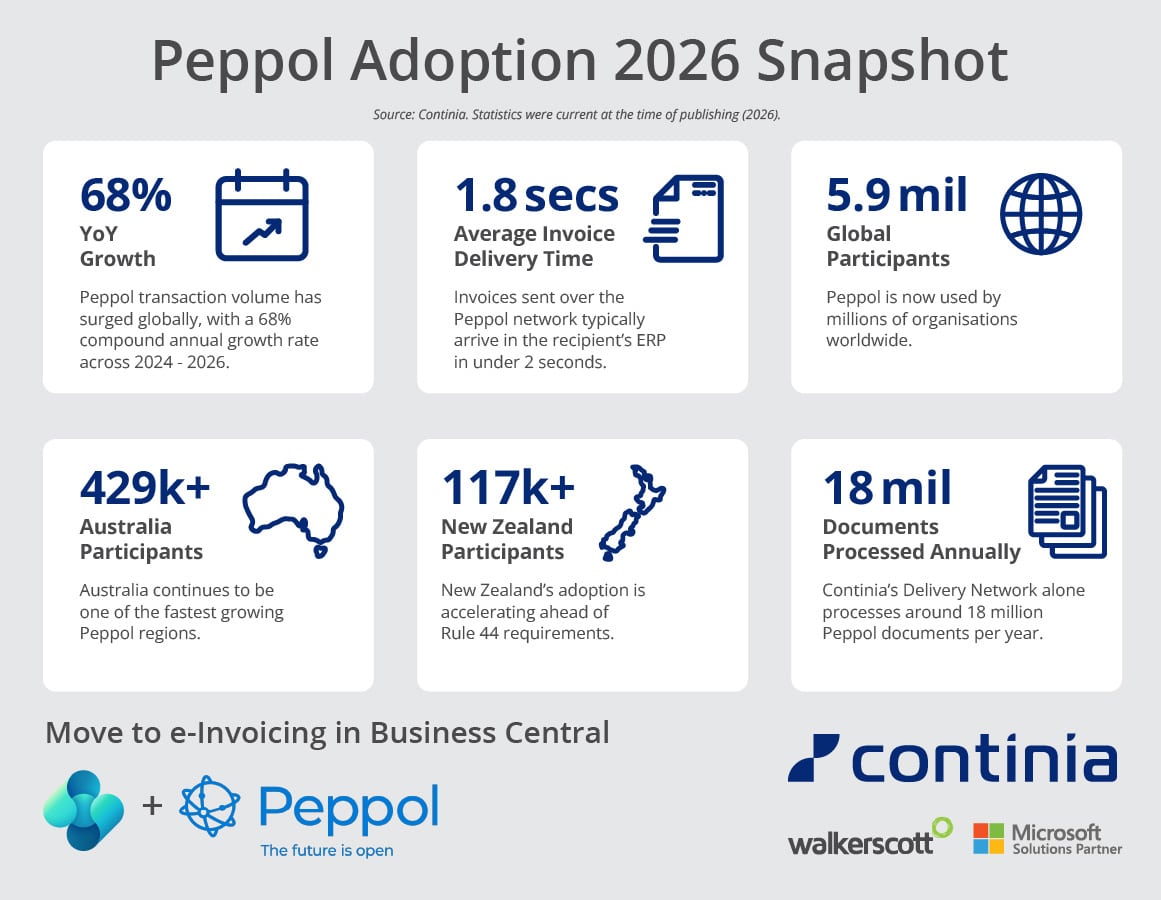
How to enable e‑Invoicing Capability to meet Rule 44 in Dynamics 365 Business Central
Enabling the sending and receiving of Peppol e‑invoices in Business Central is straightforward. E‑Invoicing Capability is delivered through a combination of Microsoft’s native Peppol support and Continia’s connected services.
Here’s what organisations need to put in place:
1. Use Business Central’s native support for the PINT A‑NZ Peppol format
Business Central already includes the PINT A‑NZ schema, the structured Peppol format used across New Zealand and Australia. This ensures invoices created or received in Business Central carry:
- structured line‑level data
- GST fields
- adjustment notes
- supply corrections
This satisfies the “Peppol compliant format” requirement of Rule 44.
2. Connect Business Central to the Peppol network through an accredited Access Point Provider like Continia
Native Peppol support alone isn’t enough. To exchange e‑invoices over Peppol, Business Central must be connected to an Access Point Provider, the gateway that sends and receives structured invoices.
This follows the standard four corner model:
Your system → Your access point → Their access point → Their system
Continia is Microsoft’s preferred e‑document solution for Business Central. Their platform provides two critical capabilities:
- Continia Delivery Network, the accredited Peppol Access Point inside Business Central
- Continia Document Capture, the invoice automation engine that processes Peppol XML, PDFs, scans, and paper invoices through one workflow
Because Continia is embedded directly into Business Central, organisations don’t need to evaluate or integrate a separate gateway.
Want to learn more about enabling Peppol e‑invoicing in Business Central? Watch our recent webinar recording for a practical walkthrough.
3. Enable receiving Peppol e‑invoices first (recommended starting point)
Most organisations begin by enabling receiving Peppol e‑invoices because:
- it delivers immediate time savings
- it requires minimal process change
- it aligns with the 2026 agency requirement
- it prepares suppliers for the 2027 mandate
Receiving Peppol invoices in Business Central is handled through Continia Document Capture, which reads Peppol XML directly into the invoice queue.
4. Add sending Peppol e‑invoices once internal processes are ready
Sending Peppol e‑invoices becomes essential for:
- large suppliers (mandatory from 1 January 2027)
- organisations selling to agencies that require Peppol capability
- suppliers wanting faster payment cycles (five day commitment)
Business Central + Continia Delivery Network handles outbound Peppol invoices using the same structured PINT A‑NZ format.
5. Handle all other invoice formats through Continia Document Capture
Rule 44 applies only to Peppol e‑invoicing, but many suppliers will continue sending:
- PDFs
- scanned documents
- paper invoices
Continia Document Capture processes all formats through one workflow, with OCR and three way matching applied automatically. This ensures finance teams don’t need separate processes for Peppol vs non‑Peppol suppliers.
6. Use Purchase Contracts for recurring supplier invoices
If you process recurring invoices like rent, subscriptions, service contracts, these can be auto approved within thresholds using Purchase Contracts, reducing manual re‑entry and keeping recurring billing compliant and consistent. This isn’t a Rule 44 requirement, but it is a significant time saver for finance teams.
Frequently asked questions about e-Invoicing in Business Central
Is einvoicing mandatory for New Zealand businesses today?
Only for government agencies (2026) and large suppliers will be mandated to have e-invoicing capability from 1 January 2027.
What’s the difference between emailing a PDF and a Peppol e-invoice?
A PDF is a document a human must read and enter. A Peppol e‑invoice is structured data exchanged system‑to‑system.
Why use Continia if Business Central already supports e invoicing?
Business Central provides the framework. Continia provides the access point, document capture, matching, and recurring‑invoice automation that make it usable day‑to‑day.