If you’ve ever chased a supplier because their invoice went to the wrong inbox, or spent an afternoon re-keying totals from a PDF into Business Central, you already know how time consuming this process can be. It works… but it’s slow, manual, and surprisingly expensive once you add up your team’s time spent fixing small errors.
Peppol e-invoicing is designed to reduce the time it takes to process invoices and it’s becoming increasingly relevant as the ATO and Australian Government push toward wider adoption.
What is Peppol eInvoicing?(It’s not the same as a PDF invoice)
Most businesses assume they’re already “e-invoicing” because they email PDF invoices. It feels digital. It feels efficient. But a PDF is still just a document, someone has to open it, read it, and type or scan the data into their system.
Peppol e‑invoicing is different. Its structured data sent directly from your accounting or ERP system to your customer’s or supplier’s system. No inbox. No manual entry. No OCR. No re-typing. No scanning.
In Australia, this structured exchange happens over the Peppol network, a secure, standardised way for two systems to communicate, regardless of what software either side uses.
The difference is simple but important:
- PDF invoice: can be intercepted, altered, or misdirected
- Peppol e‑invoice: routed securely using verified business identifiers, not email addresses
For finance teams, that means fewer errors, fewer fraud risks, and fewer hours lost to manual processing.
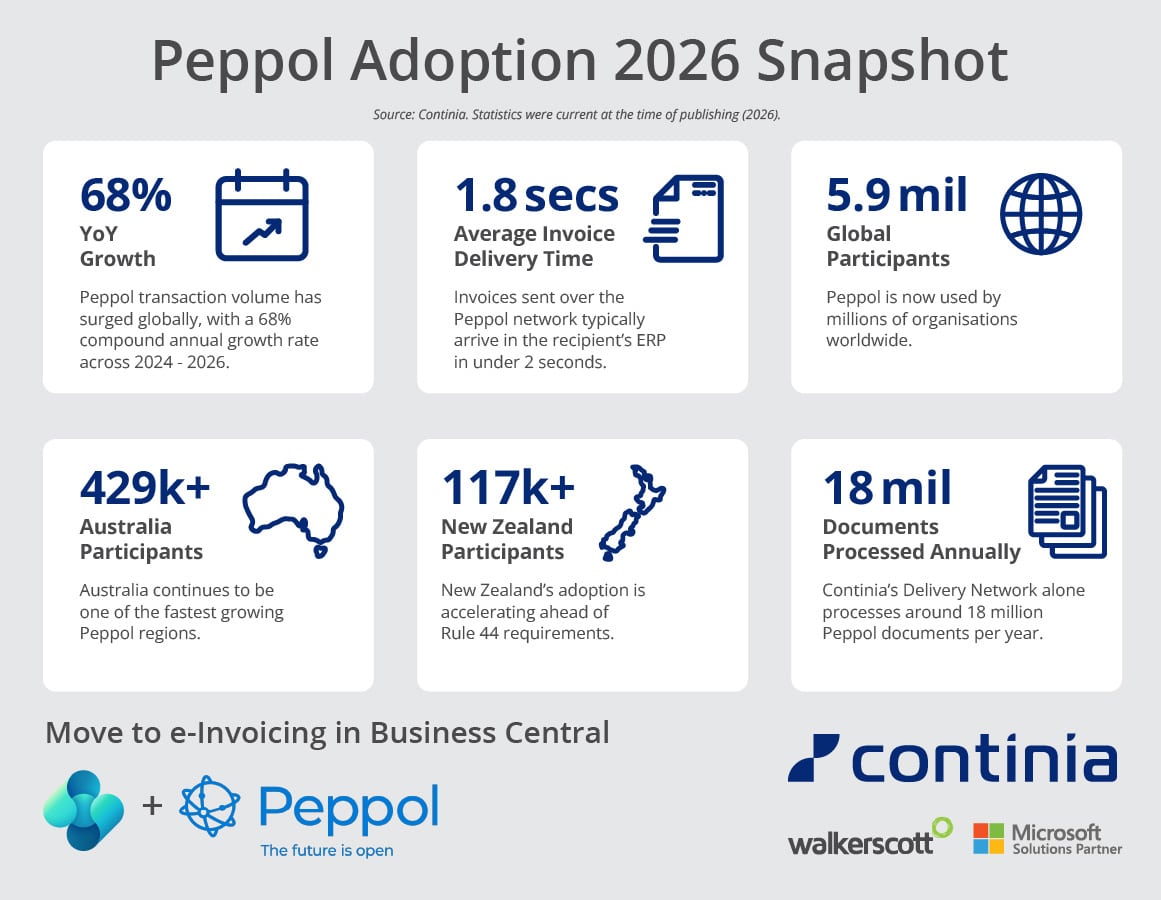
Why the ATO and government are pushing Peppol now
The biggest driver is government procurement. Since mid 2022, Commonwealth agencies have been required to receive Peppol eInvoices, and the government is targeting:
- 30% of invoices received electronically by mid 2026
- Automated processing by the end of 2026
If you supply government directly, or indirectly through a prime contractor, you’ll likely be asked for Peppol capability well before any formal mandate hits private businesses.
There’s also a strong fraud prevention angle. The ACCC recorded $227 million in payment redirection scam losses in a single year. Peppol removes the “invoice sent to the wrong inbox” attack vector entirely.
And then there’s cash flow. Eligible government agencies in Australia commit to paying Peppol e-invoices within five business days.
Does eInvoicing really matter for your average mid-sized business in Australia?
If you’re running Dynamics 365 Business Central, you are most likely already dealing with larger volume of invoices, which means you’ve already outgrown manual processes. E‑invoicing sits in the same category as AP automation, three way matching, and structured approvals. E-invoicing may not feel essential at ten invoices a month, but is increasingly valuable as volume grows.
For most organisations, the smartest path is:
- Start with receiving Peppol e‑invoices (lowest effort, biggest immediate time saving)
- Add sending later (once you’ve seen the benefits internally)
How does Business Central handle Peppol e-invoicing?
Business Central includes native support for the PINT A‑NZ Peppol e‑invoicing standard, the format adopted in Australia, which correctly carries:
- Australia’s 10% GST
- Adjustments
- Credit notes
- Supply corrections
But “native support” doesn’t mean Business Central sends invoices directly over Peppol. You still need an accredited access point provider, the gateway that connects your system to the Peppol network.
Continia’s Delivery Network provides that access point connection directly inside Business Central, so organisations don’t need to integrate or evaluate a separate third‑party gateway. This is the four‑corner model:
Your system → Your access point → Their access point → Their system.
Want to learn more about enabling Peppol e‑invoicing in Business Central? Watch our recent webinar recording for a practical walkthrough.
Where does Continia come into play with moving to e-invoicing in Business Central?
Continia’s Delivery Network acts as the access point for Business Central, meaning you don’t need a separate third party gateway. It’s now the standard e-document connector for Business Central, with a free trial available. Continia does more than just enabling the sending of Peppol e-invoices in Business Central.
Most suppliers, especially smaller ones, will keep sending PDFs, scanned invoices, or even paper for years. Continia can also handle Document Capture including:
- Peppol XML
- PDFs
- Scanned documents
- Paper invoices
Everything lands in the same queue in Continia, with OCR and three way matching applied automatically. For finance teams, that means one consistent process regardless of how the invoice arrived.
Can Peppol e-invoicing handle recurring invoices in Business Central?
Yes, recurring invoices like rent, subscriptions, service contracts, are handled through Purchase Contracts in Continia Document Capture, which auto approve within thresholds instead of needing manual re-entry every month.
If you trade with New Zealand, this is even more useful
Australia and New Zealand share the PINT A‑NZ Peppol profile, meaning structured e‑invoices flow seamlessly across the Tasman without extra integrations.
Overall benefits of moving to eInvoicing in Business Central for Australian organisations
- Fewer manual errors
- Faster payment from government customers
- Stronger protection against payment‑redirection fraud
- Cleaner audit trails
- Less time spent chasing missing invoices
- A more scalable AP process without adding headcount
And importantly: You don’t need to change how your finance team works in Business Central. Peppol e‑invoicing simply removes the manual steps around the edges.
Frequently asked questions about e-Invoicing in Business Central
Is Peppol e invoicing mandatory for private businesses in Australia?
Not at the time of publishing this. The requirement currently applies to government agencies in Australia. But suppliers to government will increasingly be asked for it, so this may change.
What’s the difference between emailing a PDF and Peppol e-invoicing?
A PDF is a document a human must read and enter. Peppol is structured data exchanged system-to-system.
If I move to e-Invoicing in Business Central, do all suppliers need to be Peppol enabled?
No, they don’t. Continia handles PDFs, scans, and Peppol invoices through the same workflow.
Does Business Central handle GST correctly on Peppol invoices in Australia?
Yes, the PINT A‑NZ standard carries GST as structured data. It’s worth confirming your configuration with your Business Central or Microsoft Solutions Partner.
Why use Continia if Business Central already supports Peppol?
Business Central provides the framework. Continia provides the access point, document capture, matching, and recurring invoice automation that make it usable day-to-day.
What is the best way to transition e-Invoicing for a mid-sized business in Australia?
Start small, consider starting with receiving Peppol invoices first. This eases your team into the transition without feeling overwhelming.